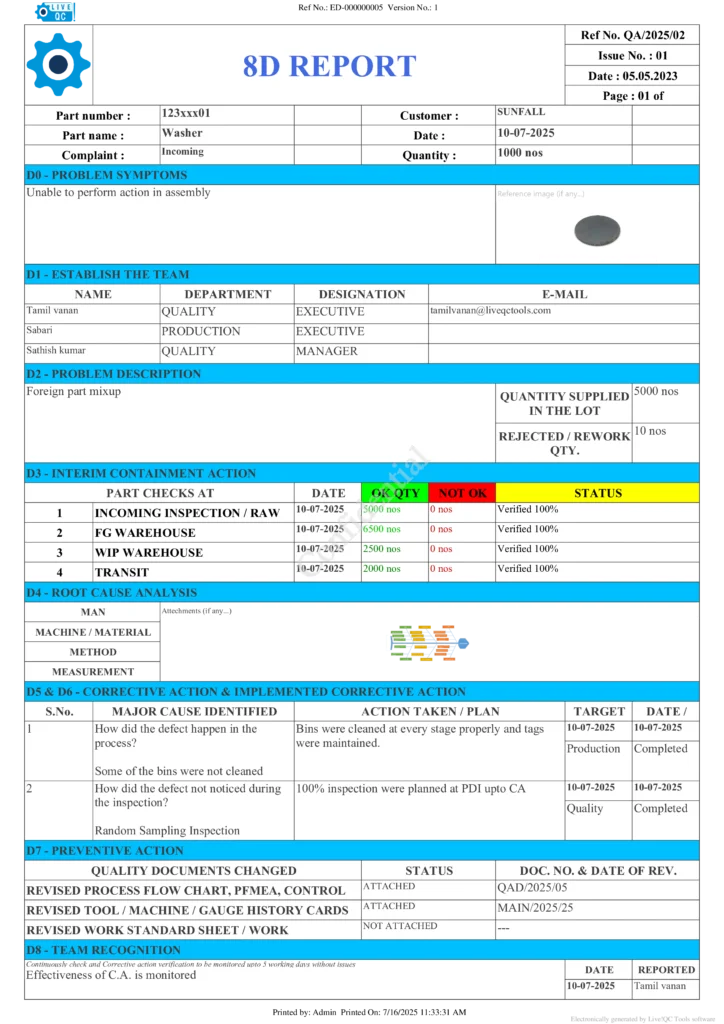
Problem solving is a crucial part of industrial operations, it is the method which helps to optimise the processes and increase production level.
Now, let’s discuss about how the 8D methods, fix and prevent the problems.
What is 8D?
8D stands for “8 Disciplines” – It is a systematic structured problem-solving technique for an unknown root cause.
It is a method with 8 steps which helps to identify, fix and even prevent recurrence of problems.
The 8D Report was created by the US Department of Defence in 1974 and then this process was developed and popularized by Ford Motor Company in 1980’s.
Disciplines of 8D?
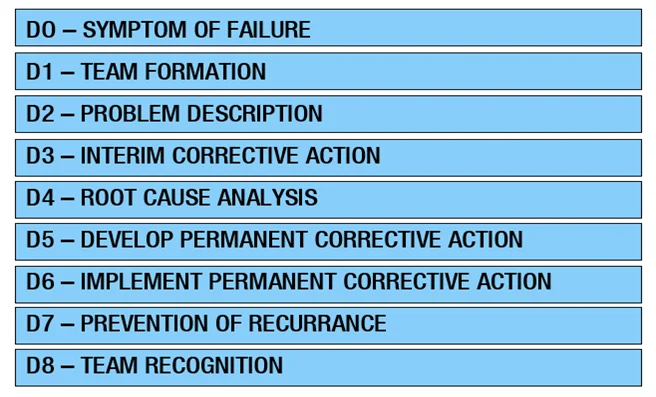
From its name, there are 8 Disciplines to execute this process successfully;
Now we can see How 8D method is created in our Live!QC Tools,
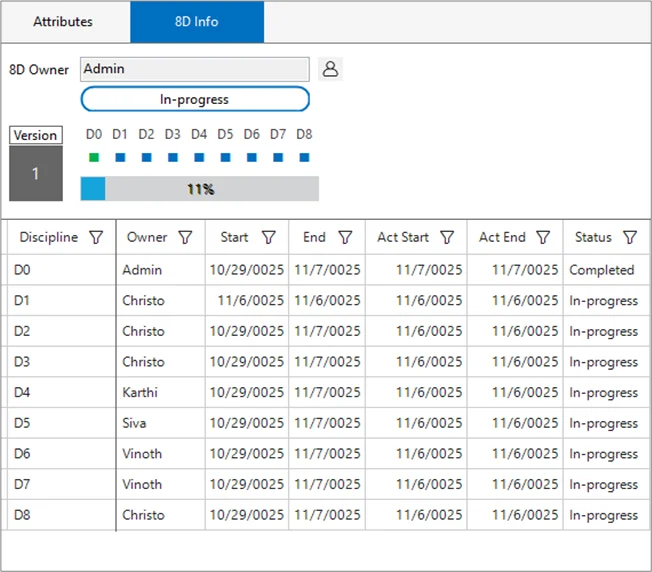
8D can be created with both Attribute details and Discipline details.
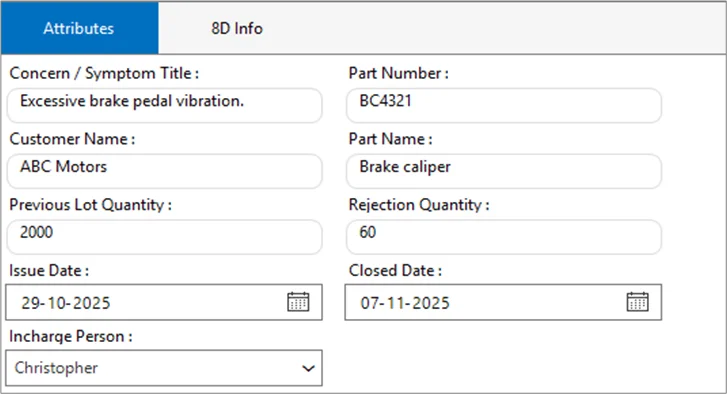
Attribute details can be used to enter the summary of the concern raised.
Starting from D0 each and every D’s can be created separately and assigned to the particular person as a task.
D0 – Voice of a customer / Planning
The first thing to do is to understand the history of problem, it is then planned accordingly why and how the problem caused and how we are going to solve the problem.
D1 – Team formation
This is the first Discipline of 8D method. In this process a team is formed consisting of different departments with process/product knowledge in the required technical expertise to fix the problem.
Team formation is very important so that a group of people can perform effectively by sharing each other’s ideas to get a better solution for a problem.
D2 – Problem description
In Discipline 2, Problem is described most accurately by a team leader to the team members based on the data and information gathered.
It is discussed from the starting point to the next step of analysis to the team. This Discipline helps us to understand the nature of the problem properly.
D3 – Interim Containment Action
After describing the problem, it’s time to take interim containment action. This step is to prevent the customer from the effect of the problem.
ICA in a short term it is a temporary solution taken to prevent the effect of the problem from affecting the customers while a permanent solution is being developed and executed.
Note: ICA should be taken within 24 hours after receiving complaint from the customer.
D4 – Root Cause Analysis
It is the main Discipline of the problem-solving process. In this stage we identify the root cause of the problem raised.
The 5 Why methods and Ishikawa diagram is used to identify the root cause of the problem.
All the possible causes are brainstormed and validated against Occurrence and Non-Detection.
D5 – Develop Permanent Corrective Action
Here the goal is to eliminate the root cause. The solution to be determined is to ensure that the problem is controlled and stopped without leading into other issues.
For determining the solution, brainstorming points are collected from RCA and then the potential corrective action is determined in non-detection point of view.
Note: Permanent Corrective Action should be developed within 5 working days from the date of complaint.
D6 – Implement Permanent Corrective Action
In this Discipline, the chosen corrective action is implemented to practice and validated. The efficiency of the corrective action should be verified based on the real time data.
Note: Permanent Corrective Action should be implemented within 20 days from the date of complaint.
D7 – Prevention of Recurrence
After the problem is fixed, we need to ensure that the problem does not repeat again. 8D method act as a problem-solving technique, their role is not only to give solution but also to prevent the recurrence of the problem.
In this Discipline we need to implement preventive measures and the effectiveness of corrective action should be monitored also check whether a similar problem did not occur in another area and rectify it by initiating horizontal deployment, also CAPA monitoring, POKA YOKE is also planned according
D8 – Team Recognition
Once the problem has been resolved, the team should finalize the 8D Report.
As a token of appreciation, congratulate the team for their efforts and let the organization knows about their accomplishment.