
Introduction
Over 60% of manufacturing defect escapes are linked to documentation failures and most of those documents are in Spreadsheets. It’s not a quality problem. It’s a system problem.
Let’s be honest – Spreadsheets are impressive. You can build almost anything in it. Control charts, Pareto diagrams, CAPA trackers, audit checklists – quality engineers across India have been doing this for decades, and doing it well.
So why more and more manufacturing companies in Chennai, Pune, and across Tamil Nadu moving away from Spreadsheets for quality management?
As teams grew, audits got tighter, and customers started demanding traceability that a folder of spreadsheet files simply cannot provide – the cracks started showing. This is the moment most quality managers recognise but few talk about openly,
The system that got you here won’t get you there.
Here’s the honest breakdown.
What Spreadsheets Does Well (And Why You Started There)
Yes, Spreadsheets can work. For a quality engineer working alone or in a small team, it works. You can create a Pareto chart in 20 minutes. You can build a CAPA log with formulas and conditional formatting. You can share it on a network drive.
It works the same way a bicycle works for a 2km commute – perfectly fine, until the distance grows. For early-stage quality processes with a small team, it’s a reasonable starting point. The moment your team grows, your audit requirements tighten, or a customer asks for traceability data – that bicycle breaks down in the fast lane.
The problems don’t start on day one. They start when you scale
The 6 Ways Breaks Down Spreadsheets as a Live!QC Tools
- Version Control Is a Nightmare
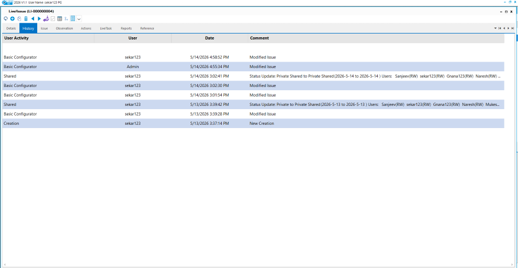
‘Which file is the latest version?’ is a question no quality manager should ever have to ask. But with Spreadsheet -based Quality Management. Files get saved as ‘Control_Chart_Final_v3_REVISED_USE_THIS’ and emailed around. Someone edits the wrong version. Data gets lost. Decisions get made on stale numbers. Instead:
Version History in Live!QC Tools Software
- There’s No Real-Time Visibility
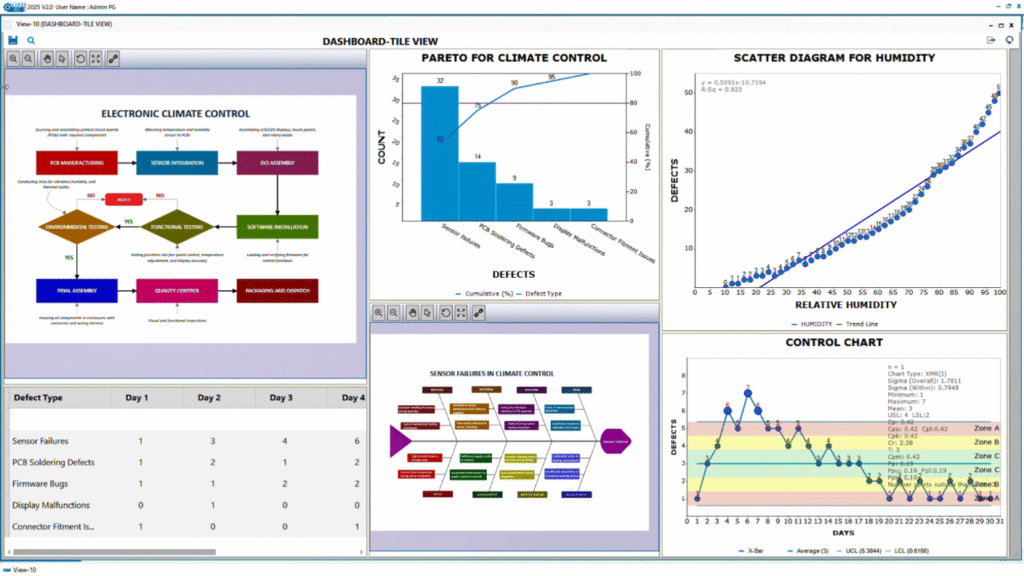
When your quality manager wants to know what is happening on the shop floor and how the issues are getting resolved – right now, a Spreadsheet-based system requires someone to physically open files, consolidate data, and compile a report. That takes hours. Live!QC Tools shows this on a live dashboard in seconds.
Dashboard in Live!QC
Tools Software
- Collaboration Doesn’t Scale
Quality management is a cross-functional activity. Production, quality, procurement, and management all need to be involved. Spreadsheets were not built for simultaneous multi-user editing and workflow management. You end up with siloed data, missed actions, and accountability gap.
- Audit Trails Are Weak
ISO 9001 and IATF 16949 require traceability. Who raised this non-conformance? Who approved this corrective action? When was it resolved? Proving this from Spreadsheet files during an audit is painful at best, and sometimes impossible if files were overwritten. What does the Live!QC Tools Does? In a Single Click of each audit, you can find out what are the NC Raised and who is responsible.
Audit- NC Management in Live!QC Tools Software.
- Data Analysis Is Manual
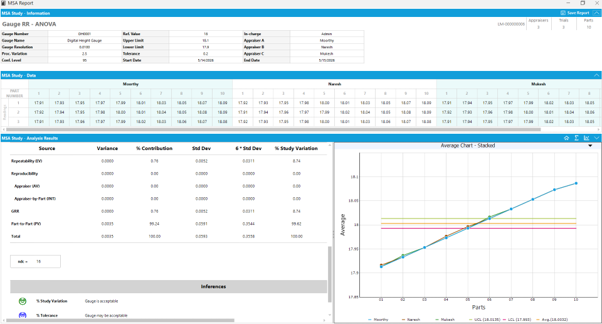
In Spreadsheet, every MSA study handles – manual calculating R&R metrics, and rebuilding charts from scratch every single time, with zero guarantee of consistency. In Live!QC Tools, giving trial data once as an input and the system automatically delivers the complete ANOVA analysis, R&R metrics, and 20 charts – with a clear inference included. No formulas. No errors. No rework.
A MSA Study
Analysis Using Live!QC Tools Software
- It Doesn’t Scale with Your Team
When you add a new quality engineer, they need to understand your entire folder structure, naming conventions, and formula logic. Onboarding someone into a Spreadsheets -based quality management can take weeks. A Centralized Quality platform with structured flow reduces this to days.
What Changes When You Move to a Digital Quality Platform
Here’s what manufacturing teams consistently report after making the switch:
- CAPA closure time reduces by 30–50% because actions are assigned, tracked, and escalated automatically.
- Audit preparation time drops significantly — all records are in one place with complete traceability.
- Quality data is always current — no more ‘let me check the latest file’ before a management review.
- Cross-functional teams actually participate in quality processes because the system makes it easy to raise issues, assign actions, and close them out.
- Management gets a real-time view of quality performance without waiting for someone to compile a report.
‘But We’ve Built Everything in Spreadsheets Already…’
This is the most common objection we hear. And it’s valid — transitioning away from a system you’ve spent years building feels risky.
The good news is that modern Quality platforms like Live!QC Tools are designed to import your existing data from Spreadsheets and CSV files. You don’t have to start from scratch. Your historical data, your quality records, your control charts — they can all migrate across.
The transition is also gradual — most teams run both systems in parallel for the first month, then sunset of Spreadsheets once the quality platform is handling everything reliably.
Spreadsheet is a grid. It was never meant to be your QMS
Is This the Right Time to Switch?
You’re probably ready to move beyond Spreadsheets if any of these are true:
- Your team has more than 5 people involved in quality processes
- You’re preparing for an ISO 9001 or IATF 16949 audit
- You’ve had a major quality escape that was partly caused by a documentation or communication failure
- Your management is asking for quality data that takes your team days to compile
Conclusion
Spreadsheets are a great starting point. It’s not a great ending point. As your manufacturing operation grows, your quality management system needs to grow with it and spreadsheets have a ceiling.
Live!QC Tools was built specifically for manufacturing teams at exactly this inflection point — teams that have outgrown Spreadsheets but don’t need a bloated enterprise platform. It’s designed to be simple, affordable, and ready to use.