From Paper Records to Digital Quality Systems
Introduction
For decades, paper records have been an essential part of manufacturing quality processes. Inspection sheets, process checklists, rejection records, calibration logs, audit reports, and corrective action forms are still commonly used across manufacturing organizations. However, as operations become more complex, a digital quality management system can help organizations manage quality information more efficiently and make it easier to access, track, and use.But recording quality information is only the first step.The more important question is:
How much of this information is actually being used to improve the process, and how much is simply being stored?
Moving from paper to digital quality management is not simply about replacing physical forms with electronic screens. The real transformation happens when quality data becomes connected, searchable, traceable, and actionable.
When quality information is captured and organized digitally, quality teams can gain better visibility into processes, identify issues earlier, and use quality data to support faster and more informed decisions. This shift is changing how manufacturing organizations manage, monitor, and continuously improve their quality processes.
Why Paper Records Still Create Problems
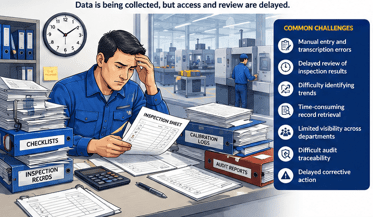
Paper records may be simple, but as production and quality data increase, their limitations become more visible.
Consider a typical situation. An operator checks a critical dimension every hour and records the readings on a paper inspection sheet. The quality engineer reviews the sheet at the end of the shift and discovers that the measurements had been gradually moving toward the specification limit.
The data existed—but the opportunity to act early was missed.
Paper-based systems can lead to:
- Manual entry and transcription errors
- Delayed review of inspection results
- Difficulty identifying trends
- Time-consuming record retrieval
- Limited visibility across departments
- Difficult audit traceability
- Delayed corrective action
What Changes When Quality Data Becomes Digital?
A digital quality system changes the role of quality data.
Instead of:
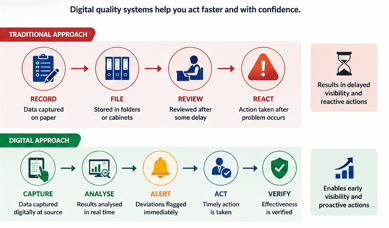
Record → File → Review → React
the process can become:
Capture → Analyse → Alert → Act → Verify
When inspection results are captured digitally, relevant trends, control limits, rejection patterns, and process performance can be analysed much faster.
Quality teams no longer have to wait until the end of the shift to understand what is happening.
A Real Manufacturing Example: CNC Machining
Consider a CNC machining process producing precision shafts with a critical diameter specification of 25.00 ± 0.02 mm.
Suppose measurements gradually move:
25.01 → 25.01 → 25.02 → 25.02 → 25.03 mm
With a paper-based system, this gradual movement may not be obvious until the complete record is reviewed. Tool wear could already have caused nonconforming parts.
With digital monitoring, the trend can become visible as measurements are entered. The engineer can investigate tool wear and adjust the process before significant scrap or rework occurs.
The important point is:Digitalization does not change the measurement. It changes what you can do with the measurement.
From Data Storage to Data Visibility
A digital quality system should do more than replace paper forms with electronic records.
It should make quality information easier to access, organize, review, and trace.
For example, a structured digital system can help teams:
- View inspection results in a centralized system
- Monitor recorded measurements and process results
- Identify deviations through defined quality controls
- Search and retrieve historical quality records quickly
- Track issues and their associated corrective actions
- Maintain records with clear traceability
This allows quality teams to spend less time collecting and searching for information and more time reviewing it and taking the required action.
The value of digital quality management is not about making decisions automatically. It is about giving the right people the right information in a structured and accessible way, so they can make better decisions faster.
Faster Traceability
During an audit or customer complaint, finding a specific record in a paper filing system can take significant time.
A structured digital system can make information searchable and connected.
For example:
Part → Batch → Inspection → Result → Issue → Corrective Action
This gives engineers a clearer quality history and reduces investigation time.
Digital Does Not Automatically Mean Better
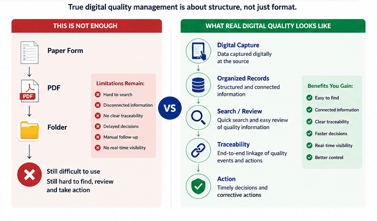
Simply converting a paper form into an electronic form does not create digital quality management.
If the process becomes:
Paper form → PDF → Folder
you may have reduced paper usage, but you have not necessarily improved quality management.
A meaningful digital system should improve four areas:
- Visibility — Information is available to the right people.
- Speed — Problems are identified closer to where they occur.
- Traceability — Quality events, decisions, and actions remain connected.
- Actionability — Data supports decisions and corrective action.
Where Digital Quality Systems Create Value
The benefits extend beyond the quality department:
- Reduced scrap and rework
- Faster problem identification
- Improved process stability
- Less time spent preparing reports
- Faster audits and investigations
- Better cross-functional visibility
- Improved corrective action effectiveness
- Stronger traceability
The real value comes when the system helps prevent losses instead of simply documenting them.
From Recording What Happened to Controlling What Happens Next
Paper records primarily answer:
“What happened?”
A well-designed digital quality system can go further:
“What is happening now?”
and ultimately:
“What should we do next?”
That is the real opportunity in digital quality transformation.
How Live!QC Tools Supports the Transition
Live!QC Tools helps manufacturing organizations move quality processes from manual records toward a structured digital environment.
Quality information can be captured, analysed, monitored, and maintained within connected quality processes instead of being isolated across paper records and spreadsheets.
The objective is not simply to eliminate paper.
The objective is to make quality information work harder.
Turning Quality Data Into Action
Moving from paper records to a digital quality system should not be treated as simply replacing forms with screens.
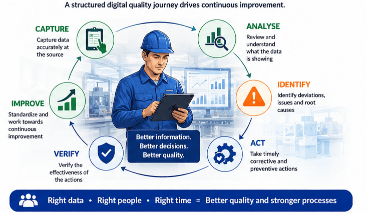
The real objective is to create a structured flow where quality information moves from data collection to analysis, decision-making, and action.
A practical digital quality journey can follow:
Capture → Analyse → Identify → Act → Verify → Improve
When quality data is captured at the source, deviations can be identified earlier. When that information is connected to issues, corrective actions, and verification, the organization moves beyond simply recording what happened.
Organizations do not need to digitize everything at once. Start with processes that create the most manual effort, delayed decisions, or limited visibility, and gradually move them into a structured digital environment.
The goal is not to become paperless for the sake of technology.
The goal is to make every quality record more useful than it was before.
When quality data can tell you what is happening, where it is happening, why it may be happening, and what needs to happen next, it becomes more than a record.
It becomes a tool for improving the process.
About Author :

Christopher A is a Technical Solutions Professional with experience working closely with manufacturing organizations to improve and digitize quality management processes. His work involves understanding real-world quality challenges and translating them into practical, structured digital solutions using platforms such as Live!QC Tools.
With a focus on quality systems, process improvement, and manufacturing applications, he shares practical perspectives on how organizations can strengthen quality processes, improve traceability, and make better use of their quality data.